

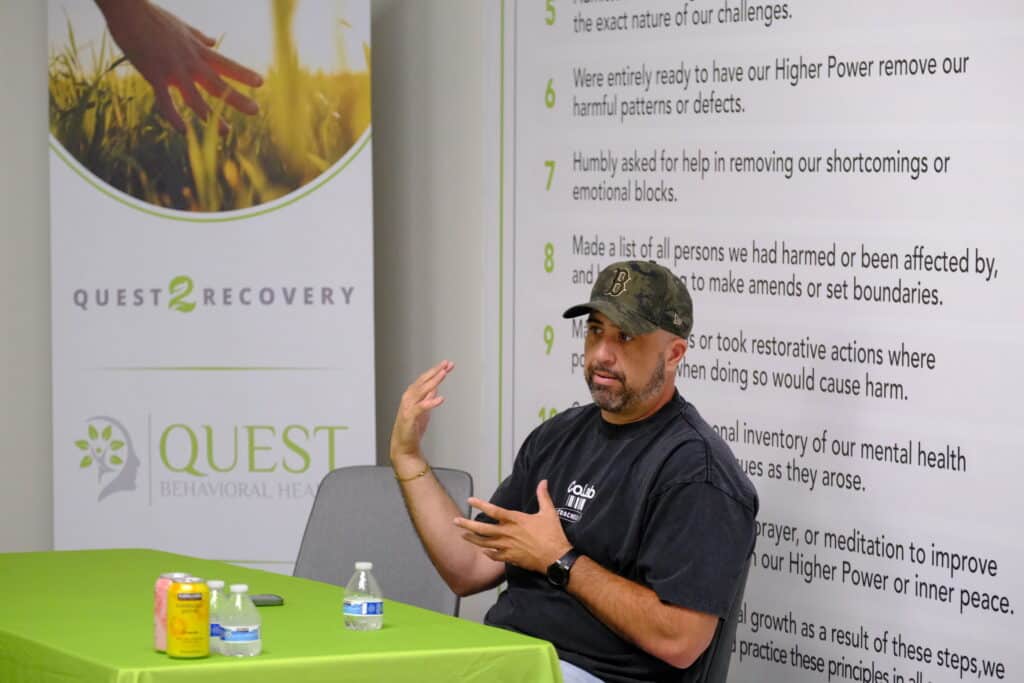
Quest Wellness Center had the privilege of welcoming a remarkable guest speaker to North Hollywood: Ryan “Bubba” Ginnetty, a Boston native, creative director, Coachella set designer, and the production manager for Grammy-nominated electronic artist Kaskade. With 15 years of sobriety behind him and a career that spans Coachella main-stage productions, MTV Video Music Awards sets, and tours with some of the biggest names in music, Bubba sat down with our clients to share something far more valuable than a résumé. He shared his story.
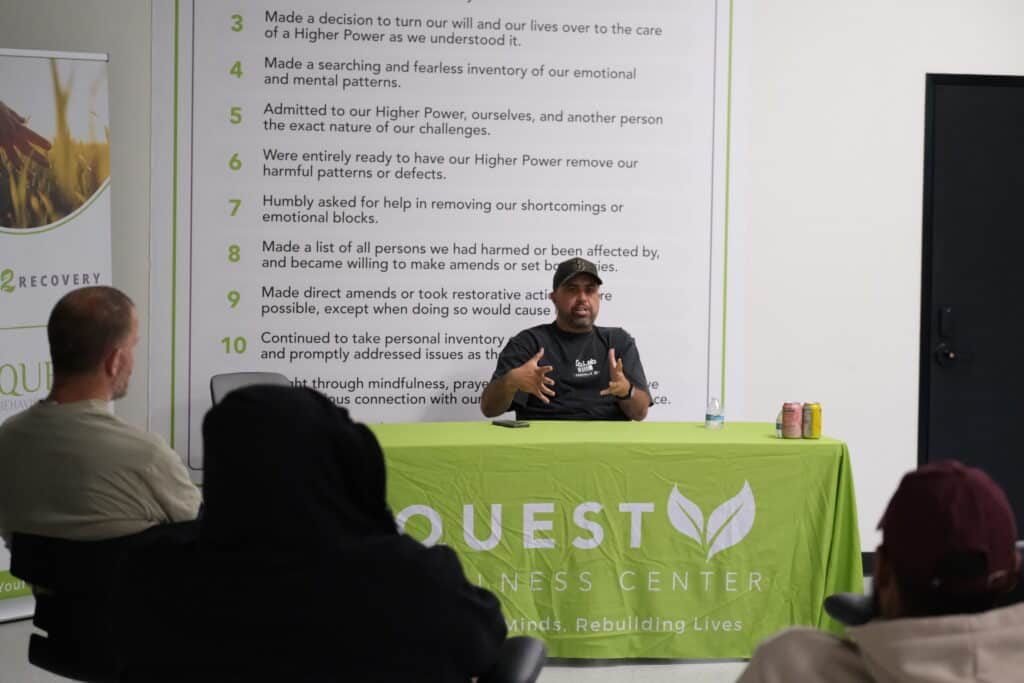
The room was full. Clients from our IOP and PHP programs gathered to hear a real, unfiltered conversation about recovery, purpose, and how a single decision can rewrite the rest of your life.
Who Is Bubba Ginnetty?
Ryan “Bubba” Ginnetty’s path into the music industry started in the most unglamorous way possible. As a senior at Fenway High School in Boston, he interned for Metro Concepts, an influential management and marketing outfit in Boston’s hip-hop scene at the time. His first big assignment was helping promote 50 Cent’s 2003 debut album Get Rich or Die Tryin’ by putting up posters and flyers, which was how artists generated buzz before social media existed.
Two decades later, Ryan was the creative director for DJ Snake’s 2024 Coachella set, which featured a jail cell-themed stage that 50 Cent appeared on as a surprise guest. As Ryan has reflected publicly, watching that moment unfold felt like confirmation that he was exactly where he was supposed to be.
Today, through his company Co.Lab, Ryan serves as a designer and creative director for major recording artists, including Sexyy Red, BIA, and the Mexican electronic duo RØZ, and as the production manager for Kaskade. His work has been featured at Coachella, the MTV Video Music Awards (including the now-iconic giant Timberland boot set built for DJ Snake and J Balvin), and major arena shows. The Boston Globe recently profiled his journey, and you can read that feature here.
But the part of his story that mattered most to our clients wasn’t the festival lineups or the celebrity collaborations. It was the part that came before all of that, and the choice that made every bit of it possible.
The Message: Life Can Change in a Single Moment
Sitting at the front of the room, with our 12-step principles displayed on the wall behind him, Bubba opened up about who he was before recovery. He has spoken publicly about his teenage years in Boston, about being more focused on drinking and smoking than on school or the people around him. Fifteen years ago, he made a decision that changed his trajectory.
His core message to the room was simple and powerful: your life can change in any single moment. The instant you decide to focus on your recovery and your well-being, everything downstream of that decision starts to shift.
For clients in the early or middle stages of treatment, hearing this from someone who has lived it for fifteen years hits very differently than hearing it from a textbook. Recovery stops feeling theoretical when the person speaking is a living example of what consistency can build.
From Street Teams to Stage Design: A Story of Reinvention
One of the most compelling parts of Bubba’s talk was how he traced the long, unpredictable arc of his career. He started by setting up game consoles and branding venues on hip-hop tours featuring artists like Common and Q-Tip. He moved to Los Angeles without a clear plan. He pursued stand-up comedy. He worked on reality television. He toured with electronic acts as the EDM scene exploded.
When the pandemic shut touring down, Bubba found himself with dwindling savings and a family to support. Instead of waiting for the world to go back to normal, he asked himself a different question: what if he took the creativity he had built up across all of those other worlds and applied it to live music itself? When touring resumed, he started pitching artists creative ideas of his own. The doors opened.
The lesson for our clients was clear. Recovery is not a pause button on your life. It is the foundation that lets you rebuild, pivot, and grow into things you could not have imagined while you were still in the cycle. Every chapter of Bubba’s career was made possible by the consistency that sobriety gave him.
Why Stories Like This Matter at Quest IOP
At Quest IOP, we have built our entire treatment philosophy around one core belief: real recovery is built through real connection. Our clinical team delivers evidence-based therapy, medication management, and individualized care plans, but we also know that lived experience is the bridge between hope and belief. That is why peer voice is woven into the fabric of our programs. When a Quest IOP client sees someone who has walked through addiction, come out the other side, and built a meaningful, creative, joyful life, the abstract idea of “long-term recovery” becomes a concrete, visible thing they can reach for.
This is the Quest IOP difference. We do not just treat the addiction; we help our clients build the life they actually want on the other side of it. That is exactly why we invite guest speakers like Bubba into our community:
- Representation of long-term recovery. Fifteen years sober is not a finish line. It is a daily practice. At Quest IOP, our clients learn how to protect that practice while traveling, working in high-pressure environments, and raising a family, exactly the kind of real-world skill set Bubba modeled in the room.
- Connection across generations and industries. Many Quest IOP clients are young adults navigating recovery while figuring out careers, relationships, and identity. Speakers like Bubba bridge those worlds in a way that feels real rather than rehearsed, and reinforce the community we work hard to build inside our North Hollywood facility.
- A reminder that creativity and recovery belong together. Sobriety does not shrink your life. It gives you the clarity and consistency to build the life you actually want, and at Quest IOP we walk alongside our clients every step of that rebuild.
Reflections from the Room
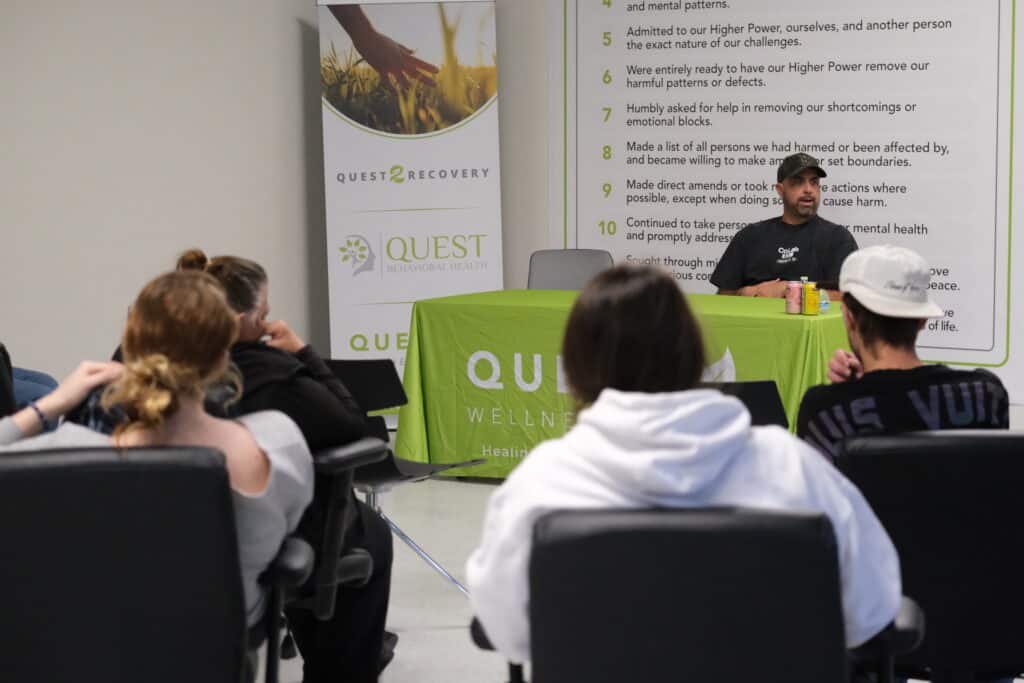
The energy in the room was something our team will not forget. Clients leaned forward. Questions were asked. People who normally stay quiet in group spoke up. There is a particular kind of silence that happens when a room of people hear something they needed to hear, and that silence was in the room with us.
Several of our clients commented afterward that hearing someone talk openly about where they came from, what they walked through, and where they are now made the work they are doing in treatment feel more real, and more worth it.
Continuing the Conversation
What Bubba gave our clients was something they will carry with them: perspective, hope, and the unmistakable proof that recovery builds rather than restricts a life.
You can follow Bubba’s work on Instagram at @bubbaginnetty.
To Bubba: thank you for taking the time to sit with our community, for speaking honestly, and for reminding our clients of what is on the other side of the work they are doing right now. Your generosity meant a great deal to our team and to our clients.
Take the Next Step Toward Recovery
Stories like Bubba’s are a reminder that recovery is not just possible, it is a doorway to a life of purpose, creativity, and connection. If you or someone you love is ready to take that first step, Quest Wellness Center is here to help. Visit our North Hollywood facility page to learn more about where we are and what to expect, explore our full range of treatment services and programs, or call our admissions team directly at (818) 275-9810 for a confidential conversation, available 24/7. Your story is not over. The next chapter starts with one decision.
Frequently Asked Questions
Who is Ryan “Bubba” Ginnetty and why was he invited to speak at Quest Wellness Center?
Ryan “Bubba” Ginnetty is a Boston-raised creative director, Coachella stage designer, and the production manager for Grammy-nominated electronic artist Kaskade. Through his company Co.Lab, he has designed live performances for DJ Snake, Sexyy Red, BIA, Shoreline Mafia, and others. Beyond his creative work, Bubba is open about being in recovery for 15 years, and that combination of long-term sobriety and a thriving creative career is exactly why we invited him. Our clients benefit enormously from hearing directly from people who have built meaningful lives in recovery.
How does hearing from a guest speaker actually help someone in treatment?
Lived experience does something clinical content alone cannot do. When a client hears a real person describe what addiction looked like in their life, what the turning point felt like, and what fifteen years of consistent recovery has built, the abstract idea of “long-term sobriety” becomes concrete and visible. Research on peer support consistently shows that connection with people in sustained recovery improves engagement in treatment, reduces feelings of isolation, and strengthens the client’s belief that recovery is achievable for them too.
Is recovery from addiction really possible after years of struggle?
Yes. Recovery is possible at any age, after any length of struggle, and after any number of previous attempts. Bubba’s story is one of millions that prove this. The most important factor is access to the right level of care combined with consistent support. Quest Wellness Center offers a full continuum of outpatient care designed to meet clients where they are, whether that is the first attempt at treatment or a return after a relapse. Our clinical team treats both substance use and the underlying mental health conditions that often drive it.
What conditions and addictions does Quest Wellness Center treat?
Quest Wellness Center treats a wide range of substance use disorders and co-occurring mental health conditions, including alcohol addiction, opioid addiction, cocaine addiction, methamphetamine addiction, anxiety, depression, PTSD and complex trauma, and dual diagnosis. Our integrated approach addresses both the addiction and the underlying conditions in the same treatment plan.
What treatment programs does Quest Wellness Center offer?
We offer a full continuum of outpatient care that includes Partial Hospitalization (PHP), Intensive Outpatient (IOP), Outpatient, and Online Therapy programs. Clients can choose morning, afternoon, or evening tracks so treatment fits around work, school, and family commitments. Therapeutic modalities include ACT, EMDR, group therapy, psychodynamic therapy, medication management, and TMS therapy.
Does Quest Wellness Center accept insurance?
Yes. Quest Wellness Center accepts most major private and commercial insurance plans. Verifying your benefits is free, fast, and completely confidential, and it does not commit you to anything. You can verify your insurance directly through our contact page or by calling our admissions team at (818) 275-9810.
How do I take the first step toward treatment at Quest Wellness Center?
Reaching out is the hardest part, and our admissions team is available 24/7 to make it as simple as possible. Call (818) 275-9810 for a confidential conversation, send a message through our contact page, or visit our North Hollywood facility to learn more about what to expect. Every call is private, every conversation is judgment-free, and there is no obligation to commit to anything just for asking questions.