






Alcoholics Anonymous isn’t a religion, but you’ll notice religious elements throughout, six of the Twelve Steps reference “God as we understood Him,” and meetings often include the Serenity Prayer. These spiritual roots trace back to the evangelical Oxford Group movement, and courts have ruled that mandatory AA attendance violates the First Amendment. However, AA deliberately uses flexible language so you can interpret “Higher Power” according to your own beliefs, and secular alternatives like SMART Recovery exist for those who prefer them. Alcoholics Anonymous isn’t a religion, but you’ll notice religious elements throughout, six of the Twelve Steps reference “God as we understood Him,” and meetings often include the Serenity Prayer. These spiritual roots trace back to the evangelical Oxford Group movement, and courts have ruled that mandatory AA attendance violates the First Amendment. At the same time, discussions around the effectiveness of alcoholics anonymous programs often emphasize that AA deliberately uses flexible language, allowing you to interpret a “Higher Power” according to your own beliefs. For those who prefer a non-spiritual approach, secular alternatives such as SMART Recovery are also available.
Is AA a Religion? No: But It’s Complicated
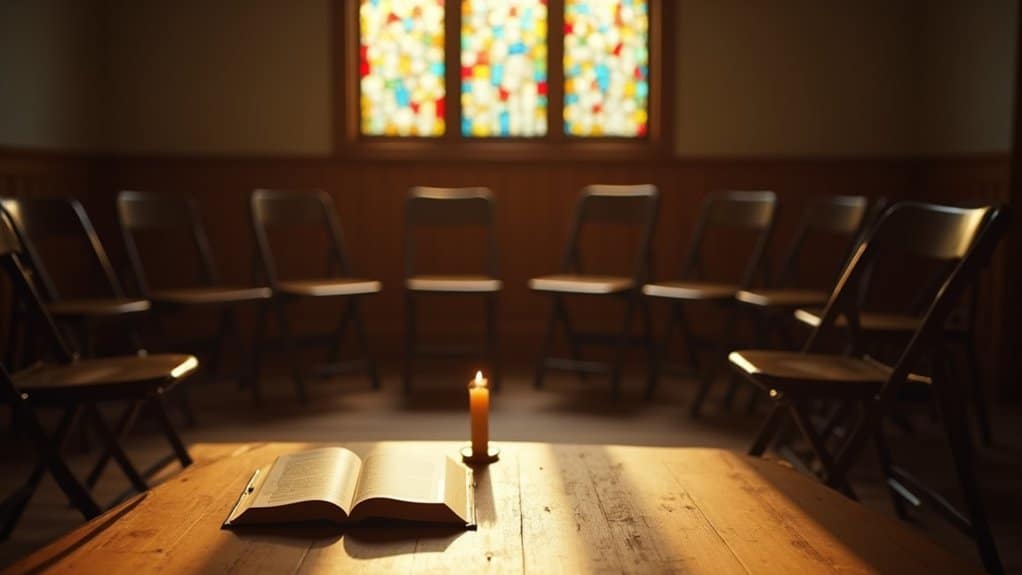
Many people wonder whether Alcoholics Anonymous qualifies as a religion, and the answer isn’t straightforward. AA presents itself as a spiritual fellowship, not a religious organization, and it’s not aligned with any sect or denomination.
However, the aa god concept embedded in the Twelve Steps has roots in the Oxford Group, an evangelical Christian movement. This historical connection means spirituality in aa carries religious undertones, even though the program welcomes diverse interpretations of a Higher Power. The program’s focus on a higher power precludes atheists from completing the entire 12 Step program as originally designed.
Courts have consistently ruled that mandating AA attendance violates the First Amendment, recognizing its faith-based elements. The Second and Seventh Circuit Courts have specifically found that court-ordered AA participation is unconstitutionally coercive. If you’re exploring secular recovery options, you should know alternatives exist. While AA isn’t technically a religion, its spiritual framework may feel religious depending on your personal beliefs and experiences.
Why AA Meetings Feel Religious (Even When They’re Not)
When you walk into many AA meetings, you’ll notice they’re often held in church basements, fellowship halls, or other religious spaces, a practical choice based on availability and affordability rather than doctrinal alignment. You’ll also encounter familiar rituals like the Serenity Prayer, moments of silence, and group recitations that mirror religious practices. These elements can create a distinctly spiritual atmosphere, even though AA officially maintains no affiliation with any religious organization. AA’s relationship with religious ideas actually does not comport with the unquestioning deep religious conviction characteristic of most organized religions. The Big Book itself describes alcoholism as an illness that only a spiritual experience can conquer, framing recovery in transformative rather than strictly religious terms.
Church Basement Meeting Locations
Although AA maintains no formal religious affiliation, the physical environment of many meetings can create a different impression. Church basements serve as traditional hosting locations because they offer practical benefits, available space, parking, and community accessibility. Pine Street Church in Boulder hosts Colorado’s largest AA group, illustrating how common these partnerships are.
You don’t need to embrace any faith to attend meetings in religious buildings. The venue reflects practical resource availability, not theological requirements. People with diverse beliefs, including atheists and agnostics, participate equally regardless of meeting location. While discussions of spirituality and higher power occur, AA functions as a non religious 12 step program focused on recovery rather than conversion. Research shows that over 75% of individuals attended at least one AA meeting over a seven-year study period, demonstrating the program’s broad accessibility regardless of religious background.
If religious symbols in church settings feel uncomfortable, secular alternatives like community centers also host meetings. Programs such as SMART Recovery have expanded rapidly, growing from 42 to 2,500 worldwide meetings, offering discussion-based formats in non-religious environments.
Prayers and Rituals Used
Walking into your first AA meeting, you’ll likely notice familiar religious elements: a prayer to open, another to close, and readings that sound like scripture. The Serenity Prayer emphasizes acceptance and wisdom, while the Twelve Steps reference a higher power AA members define for themselves.
These rituals create structure and emotional grounding for recovery, but they’re adaptable to personal belief systems. You’re not required to accept every word, newcomers are encouraged to keep an open mind rather than commit fully. The emphasis on community-driven approaches with additional rituals and practices helps foster connections and a sense of belonging among individuals facing similar struggles.
If you’re questioning whether is AA religious, consider that agnostic groups have existed since the mid-1970s, omitting prayers entirely. Many meetings now offer flexible formats that welcome diverse perspectives. The rituals serve recovery purposes, not religious conversion, they’re tools you can shape to fit your journey. For those seeking a scientifically based approach, SMART Recovery offers a secular alternative grounded in cognitive-behavioral therapy techniques.
What the 12 Steps Actually Say About God

When you look at the actual wording of the 12 Steps, you’ll find that “God” appears explicitly in six of them, but always with the qualifying phrase “as we understood Him.” The remaining steps use broader language like “Power greater than ourselves,” giving you room to define what that means personally. This intentional flexibility reflects AA’s effort to separate itself from organized religion while still acknowledging that recovery often involves something beyond individual willpower alone. The steps were originally based on Oxford Group principles, an evangelical Christian movement whose teachings included studying the Sermon on the Mount and the Book of James. Under Bill Wilson’s leadership, the 12 Steps evolved to recognize a Higher Power rather than God, allowing members of any faith tradition to participate in the program.
God References in Steps
The 12 Steps contain direct references to God, though AA’s founders deliberately chose language that allows flexibility in interpretation. Bill Wilson specifically crafted the phrase “God as we understood Him” as a concession to those with little or no faith, making the program accessible to atheists and agnostics.
You’ll find God mentioned explicitly in these steps:
- Step Three: Turning your will and life over to “the care of God as we understood Him”
- Step Five: Admitting wrongs to God, yourself, and another person
- Step Six: Being ready for God to remove character defects
- Step Seven: Humbly asking God to remove shortcomings
The inclusive phrasing translates Christian concepts into spiritual language you can interpret according to your own beliefs. Organizations like Alcoholics Victorious have drawn direct connections between each step and specific biblical scripture references, demonstrating how the 12 Steps align with Christian theology for those who choose that interpretation. For example, Step One’s admission of powerlessness over addiction and an unmanageable life directly parallels Romans 7:18, which speaks to the inability to do good through human will alone.
Higher Power Language Choices
You’ll find six of the twelve steps mention God or a higher power, but you’re encouraged to interpret these concepts personally. Your higher power might be a deity, nature, community, love, or simply the collective wisdom of other recovering members.
AA has evolved from exclusively Christian terminology to more universal language. Contemporary materials present the higher power concept as adaptable to your individual needs rather than prescriptive religious doctrine. This flexibility means you can work the steps effectively regardless of your religious background or spiritual beliefs. Some members have found success by viewing the experience, strength, and hope shared by fellow recovering alcoholics as their greater power rather than a traditional deity. What matters most is choosing a higher power that resonates with you and provides a sense of hope and inner peace.
Your Higher Power in AA Doesn’t Have to Mean God
Many people hesitate to explore AA because they assume the program requires belief in a traditional religious God. You’ll find that AA’s concept of a Higher Power remains intentionally flexible, allowing you to define it according to your personal worldview. The interchangeability of “God” and “Higher Power” in AA literature has deterred some from joining, but understanding this flexibility can open new doors.
Your Higher Power can be anything you perceive as greater than yourself. Consider these non-religious alternatives that members successfully use:
- The collective wisdom and support of your AA group
- Nature, the universe, or universal energy
- Abstract concepts like love, consciousness, or inner wisdom
- Science, mathematics, or the twelve-step program itself
What matters isn’t theological correctness, it’s finding something that provides hope and strength for your recovery. You retain complete freedom to redefine your understanding throughout your journey. The only condition is that your Higher Power feels loving and capable of supporting your sobriety.
Can You Work the Steps Without Believing in God?

How you define a Higher Power matters far less than your commitment to recovery. The 12 Steps use the phrase “God as we understood Him,” which intentionally leaves room for personal interpretation. You can replace traditional religious concepts with alternatives like the collective wisdom of your AA group, nature, science, or simply the power of human connection.
Many nonbelievers successfully reframe the Steps to align with their values. For example, Step 2 becomes believing that life is worth living sober and that you have the power to change destructive patterns. Step 3 transforms into entrusting yourself to the collective wisdom of others in recovery.
Atheists and agnostics have achieved long-term sobriety spanning 20 to 40+ years using these approaches. Your path doesn’t require religious belief, it requires honesty and willingness.
Spiritual but Not Religious: What That Means in AA
Something that often confuses newcomers is AA’s insistence that it’s “spiritual but not religious”, a distinction that matters deeply to the program’s accessibility. While religion involves organized doctrines and institutions, AA defines spirituality as personal, heart-felt experience that you shape yourself.
AA’s spirituality isn’t about adopting beliefs, it’s about discovering what personally gives your recovery meaning.
This framework means you’re not adopting someone else’s beliefs, you’re developing your own understanding of what gives your recovery meaning.
What “spiritual but not religious” looks like in practice:
- You define what “Higher Power” means without following prescribed theology
- You can interpret spiritual awakening as simply gaining abilities you couldn’t access alone
- You’re welcome regardless of religious background, including no religious affiliation
- You focus on gratitude, forgiveness, and compassion without formal religious designation
This self-constructed approach keeps AA accessible to everyone seeking sobriety. 12 steps of alcoholics anonymous explained provide a structured path to recovery, emphasizing personal responsibility and support. Each step is designed to help individuals reflect on their lives and make meaningful changes. By adhering to these principles, participants can find strength in community and transform their lives.
Where AA’s Religious Language Actually Came From
The spiritual language woven throughout AA’s program didn’t emerge from thin air, it traces directly to the Oxford Group, a Christian revivalist movement where founders Bill Wilson and Dr. Bob Smith met in 1935. This Christian ministry, founded by Lutheran minister Frank Buchman, emphasized surrender, fellowship, and spiritual principles that AA later adopted.
| Original Practice | AA Adaptation |
|---|---|
| Surrender to Jesus Christ | Surrender to Higher Power |
| Daily Bible study | Step work and meditation |
| “God” in absolute terms | “God as we understood Him” |
You’ll notice AA’s Twelve Steps were modified from explicitly Christian language to accommodate diverse beliefs. These changes, made when the Big Book was published in 1939, deliberately broadened accessibility while preserving the program’s spiritual foundation.
Why Actions Matter More Than Beliefs in AA Recovery
Your actions in the program predict your success:
What you do in recovery matters more than what you believe, your behaviors shape your outcomes.
- Attending meetings regularly creates accountability and reinforces commitment to sobriety
- Getting a sponsor reduces drinking days during your first year of recovery
- Completing the steps predicts better post-treatment outcomes regardless of religious belief
- Serving others through sponsorship lowers anxiety and supports sustained abstinence
AA’s “act as if” philosophy reflects this evidence-based reality. You don’t need to resolve theological questions to benefit. The program works through concrete behaviors that build self-efficacy and positive social connections.
Frequently Asked Questions
Can I Attend AA Meetings if I’m an Atheist or Agnostic?
Yes, you can absolutely attend AA meetings as an atheist or agnostic. AA’s Third Tradition states the only requirement for membership is a desire to stop drinking, there’s no religious test or belief requirement. You’ll find secular AA meetings that remove higher power references and emphasize personal accountability instead. Many non-believers have found lasting recovery through AA, including early members like Jim Burwell. You’re welcome regardless of your beliefs.
Will Other AA Members Pressure Me to Adopt Their Religious Beliefs?
You shouldn’t face pressure to adopt others’ religious beliefs in AA. Research shows the organization’s pragmatic approach accepts self-defined interpretations of spirituality, including secular concepts. Studies document that nonreligious members achieve recovery success without adopting religious frameworks. AA’s official stance welcomes people of all beliefs and non-beliefs, and your spiritual path remains yours to define. If you ever feel pressured, you can try different meetings to find a better fit.
Do I Have to Pray During AA Meetings?
You don’t have to pray during AA meetings. Prayer participation is optional, and you decide your own comfort level. While prayers like the Serenity Prayer are common in many meetings, you’re not required to join in. Meeting formats vary by location, and many groups accommodate members with diverse beliefs, including those who are atheist or agnostic. Your recovery doesn’t depend on prayer participation, it’s simply one available tool among many.
Are AA Meetings Held in Churches Affiliated With Those Religious Denominations?
No, AA meetings aren’t affiliated with the churches that host them. Churches simply provide meeting space as community partners, they don’t control AA’s content, structure, or spiritual messaging. You’ll find meetings in Methodist, Baptist, Lutheran, Episcopal, and many other denominational buildings, but AA maintains complete organizational independence from these host institutions. The venues are selected based on availability and accessibility, not doctrinal alignment with any particular faith tradition.
How Do I Find AA Meetings Specifically for Non-Religious People?
You can search for secular, agnostic, or atheist AA meetings through the Secular AA International Conference website or AA Agnostica’s online directory. These meetings skip traditional prayers and welcome members who have doubts about spirituality. If you’d prefer non-12-step options entirely, consider SMART Recovery, LifeRing, or Secular Organizations for Sobriety (SOS). Many offer both in-person and virtual meetings, so you’ll have flexible options for finding support that fits your beliefs.